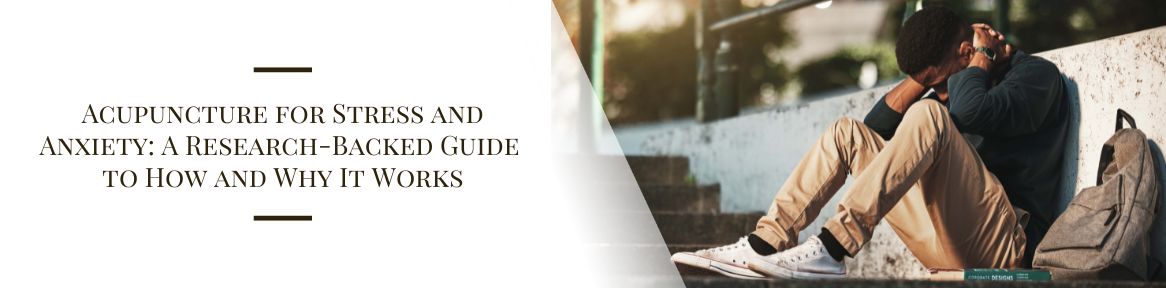
Stress and anxiety have become defining health concerns of modern life. Fast communication, demanding schedules, and constant stimulation keep many people in a near-continuous “fight-or-flight” state. Over time this activation can disrupt sleep, digestion, mood, immune function, and cardiovascular health.
While conventional treatments such as psychotherapy and medication can be highly effective, many individuals seek complementary approaches that regulate the body rather than simply suppress symptoms. One of the most studied integrative options is acupuncture, a traditional East Asian medical therapy practiced for thousands of years and increasingly validated by modern clinical research.
Understanding Stress and Anxiety Physiologically
Before discussing acupuncture, it helps to understand what anxiety is in the body. Stress and anxiety are not purely mental experiences, but neurochemical and hormonal states driven largely by the autonomic nervous system.
The autonomic nervous system has two primary branches:
- Sympathetic system (fight-or-flight): increases heart rate, cortisol, vigilance.
- Parasympathetic system (rest-and-repair): slows heart rate, improves digestion, promotes calmness.
Chronic stress shifts the body toward sympathetic dominance. This produces symptoms such as racing thoughts, muscle tension, insomnia, digestive problems, irritability, and panic sensations.
From a modern biological perspective, anxiety is therefore a regulation problem, not simply a psychological problem. Treatment works best when it restores nervous system balance. This is precisely where acupuncture enters the conversation.
What Acupuncture Does in the Body
Acupuncture involves inserting extremely thin sterile needles into specific anatomical points known as acupoints. These points correspond to areas rich in sensory nerve fibers, connective tissue planes, microvascular structures, and neurochemical receptors.
Rather than “blocking pain,” acupuncture sends signals to the brain that change how the nervous system behaves. Modern evidence suggests acupuncture can:
- Regulate the autonomic nervous system.
- Reduce cortisol and stress hormones.
- Increase endorphins and serotonin.
- Improve sleep and mood regulation.
- Normalize brain activity in emotional processing centers.
Clinical explanations align with traditional Chinese medicine descriptions of restoring the flow of “qi,” which historically described systemic regulation rather than mystical energy. Experts note acupuncture helps restore autonomic balance and shifts the body into a relaxed state where sympathetic activity no longer dominates.
Clinical Evidence for Anxiety Relief
Acupuncture has moved far beyond anecdotal support. Over the past two decades, multiple randomized controlled trials and meta-analyses have evaluated its effectiveness for anxiety disorders.
A systematic review found acupuncture effectively relieved anxiety symptoms in patients with generalized anxiety disorder with fewer side effects than conventional treatments. Another meta-analysis reported acupuncture was more effective than sham acupuncture and improved mood and sleep in GAD patients. A broader review of randomized trials concluded acupuncture has beneficial effects compared to control treatments in anxiety disorders.
Evidence suggests acupuncture may match or complement conventional care:
- A meta-analysis showed acupuncture can be superior to control interventions and safe with good patient compliance.
- Another review found acupuncture alone or combined with medication may outperform medication with fewer adverse events.
- Clinical trials demonstrate reductions in anxiety scores comparable to behavioral therapy approaches.
In clinical trials, researchers have measured objective changes, not just subjective feelings:
- reduced anxiety scale scores (BAI, GAD-7)
- improved sleep quality
- lowered salivary cortisol levels
This is important because it shows acupuncture does not merely relax patients temporarily; it changes measurable physiological markers.
How Acupuncture Reduces Stress: The Neurobiological Mechanisms
Researchers now understand several mechanisms explaining acupuncture’s calming effect. Acupuncture stimulates sensory nerves that communicate with the brainstem and hypothalamus. This reduces sympathetic activity and increases parasympathetic tone, essentially shifting the body out of fight-or-flight.
Studies show acupuncture decreases cortisol (the stress hormone) and regulates the hypothalamic-pituitary-adrenal (HPA) axis, the body’s central stress pathway.
Acupuncture promotes release of:
- serotonin (mood stability)
- GABA (calming neurotransmitter)
- endorphins (relaxation and comfort)
Neuroimaging research shows modulation of emotional centers such as the amygdala and limbic system, areas overactive in anxiety disorders.
What a Treatment Feels Like
Many patients worry that acupuncture will be painful. But in reality, needles are hair-thin (much smaller than injection needles), sensation is typically mild pressure, warmth, or heaviness and most patients feel deeply relaxed.
A typical session lasts 20–40 minutes and often produces a “reset” feeling like deep meditation or a restorative nap. Some individuals even fall asleep during treatment which is clinically meaningful, since insomnia and anxiety are closely linked. Results vary by individual, but clinical patterns are consistent.
Typical treatment course:
- Acute stress: 3–6 sessions
- Chronic anxiety: 6–12 sessions
- Maintenance: monthly or seasonal visits
Research suggests improvement may appear within about six weeks. Unlike medications, benefits often accumulate rather than disappear between treatments because regulatory pathways are being retrained.
Acupuncture as Part of a Comprehensive Anxiety Plan
Acupuncture works best when integrated into a broader lifestyle approach. Common complementary strategies include breathing exercises, sleep regulation, movement (yoga, walking), nutrition, and psychotherapy.
Natural therapies such as acupuncture are recognized as supportive options in anxiety management programs. Rather than replacing conventional care, acupuncture frequently enhances outcomes and reduces reliance on medication in appropriate cases.
When performed by a licensed practitioner sterile single-use needles are used, serious complications are extremely rare but minor bruising or fatigue may occur. Compared to pharmacological treatments, acupuncture generally produces fewer adverse effects.
Modern stress is persistent, low-grade, and physiological. It rarely shuts off. Because acupuncture regulates rather than sedates, it addresses the root pattern, likely chronic sympathetic activation. Patients often report not just reduced anxiety, but also:
- deeper sleep
- better digestion
- improved emotional resilience
- fewer tension headaches
- clearer thinking
These changes suggest improved nervous system adaptability which is the opposite of burnout.
Scientific research increasingly supports what traditional medicine has observed for centuries; acupuncture helps restore balance in systems that create stress and anxiety.
Across multiple clinical studies, acupuncture reduces anxiety symptoms, improves sleep and mood, regulates stress hormones, and works with minimal side effects.
It does not simply mask symptoms but recalibrates the nervous system. For individuals seeking a natural, evidence-based treatment that complements medical or psychological care, acupuncture offers a compelling option grounded in both ancient practice and modern neuroscience.
Acupuncture is not just relaxation, it’s neuromodulation. By guiding the body back into a parasympathetic state, it helps the brain relearn calm. And in a world that rarely slows down, that reset may be exactly what the nervous system needs.